Showing posts with label Irish Church. Show all posts

Saturday, 31 July 2010

Irish Abuse Outrage as "Painful Surgery" - Bishop

A newly appointed Irish bishop,  Liam McDaid of Clogher, has described the crisis of abuse which has rocked the church worldwide, but especially in Ireland, as "painful surgery", which was necessary, but has brought much-needed healing. It's a striking analogy, and like any surgery, it has certainly been painful and was clearly necessary. Has it brought healing, as he suggests? I don't know about Ireland, but from a broader perspective, I'm sceptical. It takes time to get over from major surgery, and recovery is never guaranteed. On the surgery executed on the church, the jury is still out. Has the surgeon's knife cut deep enough? Were the cuts and stitches made the correct ones? Only time will tell.   Before reaching a verdict and signing off on a clean bill of health, we must continue to watch the patient closely, and monitor all symptoms.

“Painful surgery” good for Church, says new Bishop

The newly ordained Catholic Bishop of Clogher Liam McDaid has said that the Church was in need of “painful surgery” in order to cleanse it of the iniquity of having been responsible for years of child abuse. 


The Bishop said that the abuse scandal which rocked the Church brought the institution to its knees, ‘but perhaps that isn’t a bad thing,’ he added.

He invited fellow clergymen and lay-person to “repentant return to the well of salvation” as he prayed for a new direction for the Church in Ireland.
A native of Bundoran, Co Donegal, Bishop McDaid said “society has forced us in the Irish church to look into the mirror, and what we saw were weakness and failure, victims and abuse. The surgeon’s knife has been painful but necessary. A lot of evil and poison has been excised.
“There comes a time when the surgeon’s knife has done what it can, is put away, and a regime of rehabilitation for the patient is put in place.
“We have been brought to our knees, but maybe that is no bad thing. It can bring us closer to the core of the mystery.”
 He continued: “So while society keeps the mirror in front of us and rightly checks that we are sincere in our intentions and efforts towards rehabilitation, can I invite you, priests and people of the diocese of Clogher, to join me in a repentant return to the well of salvation.

“The journey will include, for many, facing the enormous challenge of forgiveness.
“Despite his intense suffering, Jesus forgave those who mocked, spat at, scourged and abused him. One of the co-crucified could not bring himself beyond abuse and excluded himself; the other rose to embracing forgiveness, and was welcomed into the kingdom. There are many painful experiences in life where only forgiveness can bring closure.”

Wednesday, 19 May 2010

Cardinal Brady "Failed in His Duty", But Vows to Stay On

The head of the Irish Church's own child protection watchdog has found that Cardinal Brady clearly failed in his duty to safeguard children. Even so, the Cardinal has vowed to stay on.

From the Irish Times:

CATHOLIC PRIMATE Cardinal Seán Brady was wrong in his handling of 1975 child sex abuse investigations, the head of the church’s child protection watchdog said yesterday.
Ian Elliott, chief executive of the the National Board for Safeguarding Children (NBSC), also said it “would have been helpful” had the cardinal disclosed details of the matter sooner than their disclosure in newspapers last March.
In 1975, the then Fr Brady conducted a canonical investigation into child sex abuse by Fr Brendan Smyth in Kilmore diocese and swore to secrecy the two teenagers involved, whom he believed.
He passed a report on the matter to his bishop, but did nothing more. Smyth continued to abuse children for a further 18 years.
Asked yesterday whether he believed the then Fr Brady had dealt with the matter correctly, Mr Elliott said: “No. He didn’t handle it properly from the safeguarding of children point of view. You could not say that the action taken prioritised the safeguarding of children.”
He was “quite sure if you posed the situation to the cardinal today . . . other actions would have been taken.”
Mr Elliott said he had written to Cardinal Brady following his request on Monday that the NBSC prioritise Armagh archdiocese in its new audit.
(Read the full report)


Meanwhile, the Cardinal insists he will not resign. From the Belfast Telegraph:

Irish victims of clerical abuse have expressed disappointment that Cardinal Sean Brady is to stay on as Primate despite their calls for his resignation over his role in the 1975 cover-up of paedophile priest Brendan Smyth.
Maeve Lewis, executive director of the One in Four support group, said Cardinal Brady had allowed many other children to be sexually abused and their lives to be devastated by his failure to report Smyth to the authorities.
“Cardinal Brady states that he has consulted with survivors,” she said. “He certainly has not listened to what they have said.
“Survivors who are in contact with One in Four are very clear that they need senior Catholic churchmen to be accountable for what they have done — and to resign.”
Ms Lewis said that if Cardinal Brady was genuine about overseeing change, he should challenge responses victims meet when they attempt to bring their experiences to the attention of authorities.

Tuesday, 18 May 2010

Irish Report Marks "Tangible Progress"

ON MONDAY of last week, in his much discussed address to the Knights of Columbanus, Archbishop of Dublin Diarmuid Martin spoke of “strong forces” in the Catholic Church “which would prefer that the truth did not emerge” about clerical child sex abuse.

Yesterday we were presented at a press conference in Dublin with one of those strong forces in the church which is even more determined that the truth will emerge.

There is no doubt that the National Board for Safeguarding Children in the Catholic Church in Ireland (NBSC) has earned its credibility. Its uncompromising uncovering in 2008 of “inadequate and in some respects dangerous” child protection practices in Cloyne diocese represented a baptism of fire for the fledgling board and its then new chief executive Ian Elliott.

But it stuck to its guns, eventually persuading Cloyne diocese to publish that damning report on its own website in December 2008.

The result was the resignation of Bishop John Magee and an extension of the remit of the Murphy commission to include Cloyne diocese, which it is now investigating.

Similarly, the NBSC decision to yesterday “name and shame” three dioceses which have been tardy in appointing parish safeguard representatives will have earned them few friends in Killala, Clonfert, and/or Ossory. But it is another uncompromising move towards ensuring children are safe in Catholic-run contexts on this island.

The obstinacy of the NBSC in pursuit of this aim and in particular of its chief executive, Elliott, has prompted some humour, with a recognition that much of the church’s future credibility where child protection is concerned rests on the shoulders of a Presbyterian, which Elliott is.

A native of Dublin and a Trinity College graduate, he has spent most of his working life in Northern Ireland, where he implemented major reforms in child protection services for the Department of Health and Social Security there.

Such was his reputation that he was head-hunted by the Catholic Church to become chief executive of the NBSC in July 2007.

That alone indicated a serious commitment by strong forces within the church to properly address child protection.

The continuing and unequivocal support that Elliott and the NBSC have received from church authorities, through the Cloyne upheaval and the fall-out from the Ryan and Murphy reports, indicates a sharp change of approach to this catastrophic issue by most of the church’s authorities in Ireland.

It is, however, a work in progress.

As NBSC chairman John Morgan, who has been dealing with child protection issues on the church’s behalf since 1999, said in a statement accompanying yesterday’s report, from the NBSC perspective “the best thing we can do is help change the future – and that is our pivotal emphasis”.

He went on to say that “clearly a cultural correction is required in the Irish church to deal with the problem of abuse”.

He said “there is little apparent recognition that Vatican II decisively moved the role of the church lay faithful from collaboration to co-responsibility. A form of collective authority in the safeguarding of children might assist the ushering in of a wider recognition of the principle of co-responsibility.”

The NBSC intended “to participate in this crucial debate”, he added.

For his part, Elliott was as uncompromising. “The radical change imperative within the church is an acceptance that the safety of the child is paramount,” he said. All other considerations, including the reputation of the church, the hierarchy, or any member of the clergy, “comes some way after the safety of the child in any consideration of decisions to be made or actions to be taken”.

He warned that “within some areas of the church, this commitment has been tempered by a mistaken belief that it is possible to continue with past and familiar practices”.

That, to quote Margaret Thatcher, is “out”.

In more than an echo of Archbishop Martin’s address last week, Elliott said that this approach had led to “a reliance on a defensive legal response when complaints emerge rather than a focus on safeguarding concerns and the elimination of risk to other vulnerable young people”.

Radical change required “nothing less than a major step away from the defensiveness of the past to a more open and accountable future,” he said.

And where abuse victims were concerned, he said the church “must improve significantly” in “communicating a sense of regret and remorse for what has happened, along with a sincere concern for their present wellbeing.”

Such victims were also “a great source of wisdom and guidance about what mistakes to avoid in the future,” he said.

Elliott’s comments on the Christian Brothers yesterday were unexpected. Of all 18 congregations investigated by the Ryan commission it had been the most recalcitrant and reluctantly co-operative. It also emerged very badly from the Ryan report.

Elliott said that since publication of that report last May the Christian Brothers had been “working diligently” to ensure that all information they held on members suspected of being involved in abuse was reported to statutory authorities and to the NBSC.

The organisation also now had a mandatory reporting policy in place. The Christian Brothers had become “an excellent example to be followed by the church” and were deserving of “the highest praise”, he said.

Quite a turnaround, and a welcome one, for a congregation which had been denying any abuse had taken place in its institutions five days before publication of the Ryan report on May 20th last year.

Irish Times

Saturday, 8 May 2010

Two More Irish Resignations

Pope Benedict XVI on Thursday accepted the resignation of two Irish bishops, bringing to five the number of bishops to resign since the abuse crisis hit the Roman Catholic Church in Ireland. In a statement, the Vatican said that Joseph Duffy, bishop of Clogher, and Francis Lagan, the auxiliary bishop of Derry, stepped down after reaching the retirement age of 75. Bishops are required to tender their resignations at 75, but the pope can decline to accept and, in some cases, he has kept bishops well past that age. In March, Bishop Duffy said that he had known about abuse allegations against a priest in his diocese but that he had not told the civil authorities at the request of the victim’s parents, Irish news media reported. The priest was later jailed.


(From New York Times)


The Belfast Telegraph has described Msgr Liam McDaid, who was named to replace Bishop Duffy, as a "conservative" choice. Meanwhile, there is still no indication whether he will accept the resignations of two other Irish bishops, who tendered resignations in December, after being criticized in the Murphy report fr inaction over the abuse scandals.


(Read more: http://www.belfasttelegraph.co.uk/news/local-national/pontiff-goes-conservative-as-he-names-new-bishop-14796626.html#ixzz0nLxqQehV)

Thursday, 1 April 2010

Abuse: State Inquiries For Northern Ireland, Switzerland.

The really important feature of the story of church abuse in Ireland, was that the Murphy report, which resulted in special attention by Pope Benedict XVI and paved the way for an opening of the floodgates of disclosure across Europe, was that it was an investigation by a national government, not into the abuse itself, but into the cover-ups: in effect, this was an investigation into the affairs and modus operandi of Catholic Church itself. IT may be this example that has prompted the German government to plan a similar investigation of their own, although the Chancellor Angela Merkel has said it will cover more than just the Catholic Church.

The Murphy report, though did not cover all of Ireland, just the diocese of Dublin. With the peculiar political structure of a divided Ireland, it was perhaps inevitable that the government of Northern Ireland should want an enquiry of their own, and now it seems they are going to get one. (Technically, this is part of a separate country, the UK, but falls under the jurisdiction of Cardinal Brady, who is primate not just of the Irish Republic, but is "Primate of all Ireland".) Like Germany, this will investigate abuse across a wide range of institutions, not just the Catholic Church.

Together with the German investigation, this will surely encourage still more governments to conduct inquiries of their own.

Sunday, 21 March 2010

Benedict's Pastoral Letter: More Questions than Answers

Was a "pastoral letter" the appropriate response in the first place?

Since its release yesterday, I have read the full letter, as well as assorted summaries and commentaries, by churchmen, journalists and victims' groups.  Reflecting on it, I simply come up with more questions than answers - so many, in fact, that I propose to respond not in a single post, but in a series.  Yes, there are other useful things I could be writing about, would prefer to be writing about: I am bursting to get down some posts which elaborate on James L'Empereur's  ideas of the charism and spiritual gifts of gay spirituality,  and on what (global) history has to say about the family, sex and natural law, for instance.  but this response to the greatest crisis facing the church in recent history is so important, that other issues will have to wait.  I ask for the patience and indulgence of my non-Catholic readers, who may find the whole sordid saga too much to pay attention.

The first and most important question, which I have not seen raised anywhere else, is why on earth should the idea of a pastoral letter even be considered appropriate in the first place? as I look at it, there is a sense in which, unless it contains extraordinary wisdom (and this one patently does not), the very idea simply perpetuates part of the problem.  This point was driven home to me as I read the responses of too many bishops and Vatican spokesmen, which one phrase constantly recurs: the "Holy Father".  Like "pastoral" itself, these words in this context, are misleading and harmful.


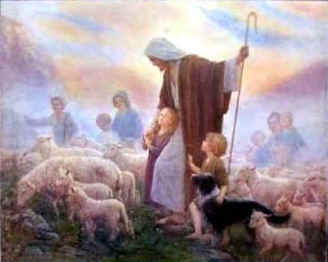
The "Good Shepherd: Jesus Christ, or Benedict XVI?

"Pastoral" of course, is a word widely used in the Church to describe the nature of the relationship between church and people, and is also widely used elsewhere, as in schools.  The problem lies in its hidden connotations.